
Reviewed · WALKING TOURS
Discover Valletta Half-Day Walking Tour
Valletta’s key sights, in one tidy walk. I like the easy meeting point and the way this half-day route stays efficient without feeling like a sprint. You cover a lot of ground, from the modern Triton Fountain to the Grand Harbour viewpoints, with history explained along the way. One consideration: most big indoor stops have separate admission, so what you pay later depends on which museums or churches you choose to enter.
This is a group walk that lasts about 3 hours 15 minutes, starting at 9:15 am and ending around 12:45 pm. You still get some built-in breathing room, especially at Upper Barrakka Gardens and St John’s Co-Cathedral, then you can top it off with the Malta Experience show at 13:00. If you want a fast orientation plus options to go deeper, it’s a strong fit.
In This Review
- Key things that make this Valletta walk worth your time
- Why this 3-hour 15-minute Valletta walk actually works
- Price and value: what you pay (and what you don’t)
- Logistics that matter: where you start, where you end
- Triton Fountain to City Gate: modern Malta at the edge of the old city
- Republic Street spine: City Gate, the New Parliament, and Renzo Piano’s style
- Auberge de Castille: Baroque power and the Prime Minister’s address
- Upper Barrakka Gardens: your planned Grand Harbour break
- MUŻA at Auberge d’Italie and Palazzo Parisio’s Napoleonic twist
- St John’s Co-Cathedral: choose your ticket plan wisely
- St George Square and the Grandmaster’s Palace museum option
- Fort St Elmo: star fort setting and the National War Museum
- The Malta Experience at 13:00: an easy way to finish with story
- Group-tour reality checks: what to expect from the guide and pacing
- Who should book this Valletta half-day walk, and who might want more time
- Should you book this tour?
- FAQ
- How long is the Discover Valletta half-day walking tour?
- What time does the tour start and end?
- How much does the tour cost?
- What is included in the tour price?
- What is not included?
- Where do I meet for the tour?
- Where does the tour end?
- Do I get any free time during the walk?
- What is the Malta Experience show?
- What is the cancellation policy?
Key things that make this Valletta walk worth your time
- A morning-friendly schedule (about 9:15 to 12:45), then you are free to roam
- A modern-to-classic route starting at the Triton Fountain, then moving into Knights-era Valletta
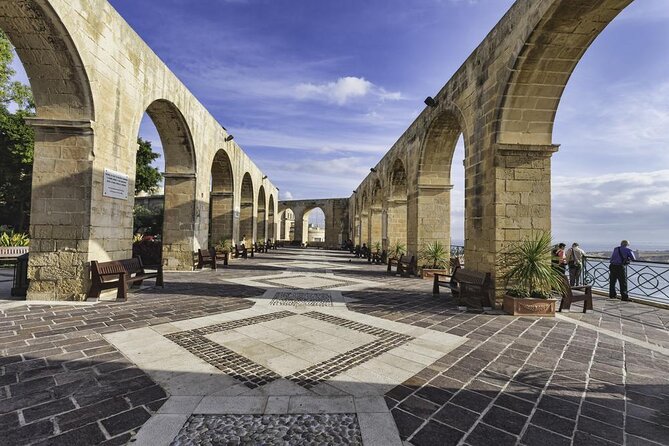
- Real viewpoints included, especially Upper Barrakka Gardens over the Grand Harbour
- A serious church stop built in, with 45 minutes free at St John’s Co-Cathedral and Museum
- Renzo Piano’s fingerprint shows up more than once, from City Gate work to the opera house ruins
- A fun wrap-up option at the Malta Experience audiovisual show (13:00, 45 minutes)
Why this 3-hour 15-minute Valletta walk actually works
Valletta is small, but it can feel big when you arrive with no plan. This tour helps you get your bearings fast, because you start near the city entrance and then work inward toward the harbor side forts. The pacing is designed around a group walk, so you move, you listen, and you get a couple of planned breaks where you can just look.
I also like that the tour is structured but not rigid. Your guide covers the highlights and story, then you choose what to pay for. That matters in Valletta, where admissions can add up if you try to see everything.
Finally, you end at a place that makes sense. Instead of dropping you in some random alley, the tour finishes near St Elmo, where you can watch the Malta Experience show and grab a drink or snack with harbor views.
More Guided Walks in Malta:


Price and value: what you pay (and what you don’t)
The cost is $22.11 per person, which is a fair price for a licensed guide covering a long stretch of the peninsula city. Because it is a group tour, your guide time and route planning are shared, keeping the price down.
What is not included is equally important. The tour does not include museum or church admissions, so you will likely spend extra if you go inside:
- St John’s Co-Cathedral and Museum
- Auberge sites when they are ticketed
- Grandmaster’s Palace State Rooms and Armoury (if you choose)
- Fort St Elmo areas that are ticketed
- Malta Experience show (45 minutes at 13:00)
If you are the type who enjoys browsing from the streets and viewpoints, you can keep your day affordable. If you want interiors and guided museum time, set aside more budget.
Logistics that matter: where you start, where you end
You start at the Phoenicia Malta, The Mall, Floriana at 9:15 am. That is helpful because Floriana is right by Valletta, and you avoid a long cross-island commute.
The walk ends at the Malta Experience entrance, St Elmo Bastions around 12:45 pm. The show starts at 13:00 and lasts 45 minutes, and the entrance is not included. You can also stop for food and a drink with Grand Harbour views before heading back at leisure.
One practical tip: arrive early and be on time. One guide named Maria was noted for great energy, but there was also a complaint about the group waiting nearly an hour for everyone to arrive. So if you want the smoothest start, do not show up at the last minute.
Triton Fountain to City Gate: modern Malta at the edge of the old city
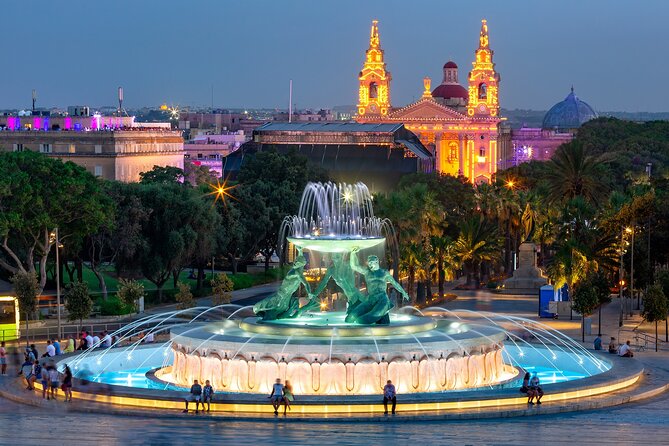
You kick things off near the Triton Fountain, just outside Valletta’s City Gate. The Triton Fountain is Malta’s modernist landmark, with three bronze Tritons holding up a basin. It was inaugurated in 1959 and restored in 2018, so it is not just a decorative piece. It is a clue that Valletta did not stop evolving after the Knights era.
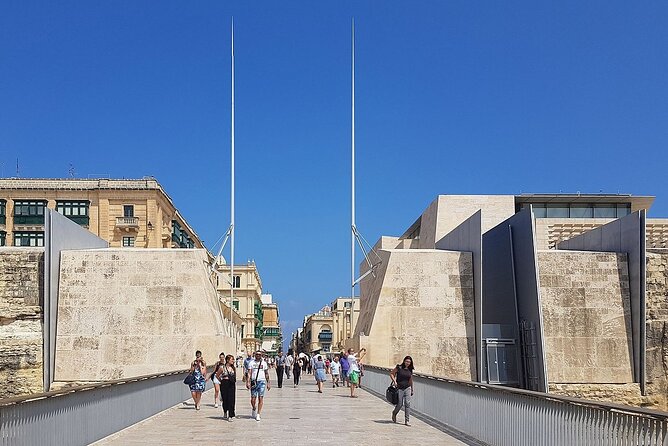
From there, you move into the City Gate area. Valletta’s City Gate sits in the Porta Reale Curtain, a curtain wall connecting St James’ and St John’s Bastions. The gate marks the beginning of Republic Street, Valletta’s main spine, stretching all the way toward Fort St Elmo.
When you understand this layout, the rest of the day clicks. Republic Street is the thread that ties together the Grandmaster’s core, the cathedral, and the way out to the forts.
Republic Street spine: City Gate, the New Parliament, and Renzo Piano’s style
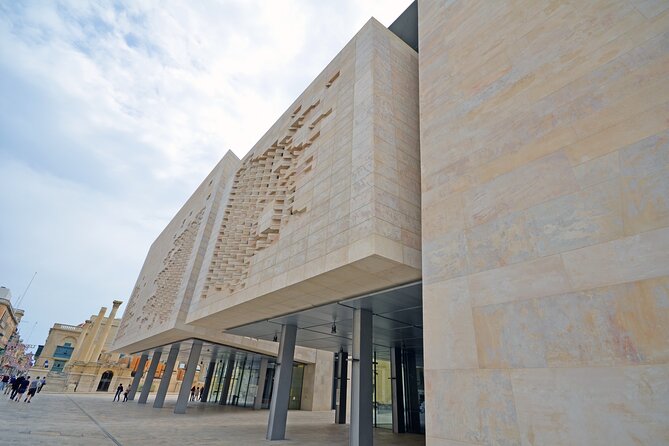
The tour then passes the New Parliament building, constructed between 2011 and 2015, designed by Renzo Piano. The building is two linked blocks and uses a steel frame clad in Gozitan limestone. The design idea is that it represents honeycombs, tied to the meaning behind Malta from Melite, described as honey.
Even if you are not into architecture, this stop is useful because it shows how modern Malta fits into a city of stone ramparts. You are not just looking at old walls. You are walking through a living city.
Next, you reach the Royal Opera House site, where the original theater was completed in 1866 and hit by aerial bombing in 1942. The ruins were redesigned by Renzo Piano, and performances resumed in 2013. It is a good reminder that Valletta’s story includes destruction and reinvention, not just preservation.
Other ways to spend a sunny hour in Malta
- Malta: Half-Day Quad Bike Adventure Tour Including Transfers★ 4.7 · 185 reviews
- Valletta: Half-Day City Discovery Walking Tour★ 3.9 · 157 reviews
- Half-Day Tour of Mosta, Ta’Qali Crafts Village & Mdina★ 4.1 · 110 reviews
- St. Paul’s Bay: Half-Day Luxury Catamaran Tour with Drinks★ 4.9 · 58 reviews
- Valletta Half-Day Guided Tour with Optional Cathedral Tour★ 4.0 · 58 reviews
Auberge de Castille: Baroque power and the Prime Minister’s address
Auberge de Castille sits at the highest point of Valletta, in the Baroque style, built in the 1740s under Manuel Pinto da Fonseca. It replaced an earlier 1574 building built for Knights of the Order of Saint John from the langue of Castile, León, and Portugal.
Today, Auberge de Castille houses the Office of the Prime Minister of Malta. That simple fact changes how you read the building. It is not only a beautiful relic, it is a current seat of government.
If you love visual scale, this is one of the best moments to pause. The view lines and the way the street drops away help you feel Valletta’s geography, which is part of why the fortifications matter so much.
Upper Barrakka Gardens: your planned Grand Harbour break
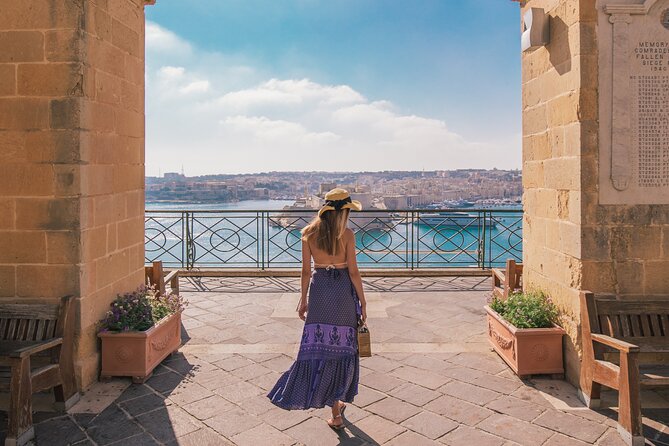
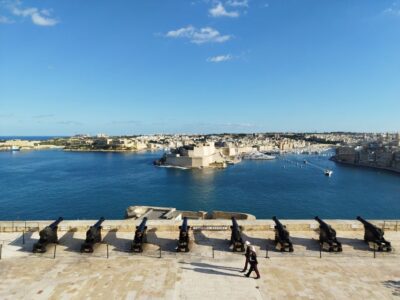
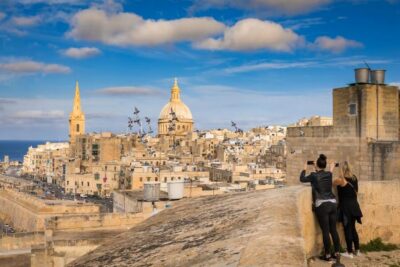
Upper Barrakka Gardens is your first big payoff view. This is where you get free time to just stand and take it in. The gardens are on the upper tier of St Peter and Paul Bastion, built in the 1560s, and they were originally recreation space for Knights of the Order.
Because it sits high on the city walls, you look over the Grand Harbour, the Three Cities, the shipyard, and the lower parts of the capital. Even on a busy day, you can find a spot to slow down.
This is also a smart time to decide how your afternoon will go. If the view already made you want more, you can consider adding a museum or a second walk later. If you prefer outdoor time, you can skip some indoor ticket stops and keep exploring at your own pace.
MUŻA at Auberge d’Italie and Palazzo Parisio’s Napoleonic twist
Two more “story-loaded” buildings come next.
At Auberge d’Italie, built in the late 16th century for the Knights of the Order from the langue of Italy, the building became the National Art Museum MUŻA in 2018. This is an example of Valletta reusing historic structures for modern cultural life.
Then comes Palazzo Parisio, built in the 1740s by Domenico Sceberras. It passed into the Parisio Muscati families, and it mattered during the French occupation. Napoleon stayed here for six days in June 1798. Later, the government used it as the General Post Office from 1886 to 1973, then for the Ministry for Agriculture, and it is now tied to the Ministry for Foreign Affairs.
These stops are short on purpose, but the context makes them land. You can look at stone and think it is fixed in time, but Valletta keeps flipping chapters. One building can represent Knights, a new nation, and still another use in the modern era.
St John’s Co-Cathedral: choose your ticket plan wisely
The tour gives you 45 minutes of free time at St John’s Co-Cathedral and Museum. Admission is not included, but you can buy tickets during that window.
This matters because the cathedral interior is a major reason people come to Valletta. The co-cathedral’s Oratory features Caravaggio masterpieces, there are Flemish tapestries, and there is also a church museum. The marble inlaid floor is noted as one of the most beautiful in the world, and entrance includes a multilingual audio guide.
You also have other small options during the same block of time. You can shop along Republic Street, or relax in Republic Square and nearby piazzas if you decide you would rather not pay for interior entry.
My practical advice: if you want the full experience, go straight in and plan to use the audio guide. If you are short on time or your budget is tight, you can focus on the outside and the cathedral area only from where you can without tickets.
St George Square and the Grandmaster’s Palace museum option
Next is St George Square, also called Palace Square. It is Valletta’s largest and most prominent square, right in the heart of the city in front of the Grandmasters’ Palace.
The palace area matters because it was the seat of power for centuries. The Grandmaster’s Palace, built between the 16th and 18th centuries, was the palace of the Grand Master of the Order of St John, who ruled Malta. Later, it served as the seat of Parliament between 1921 and 2015. Today, it houses the Office of the President and the Palace State Rooms and Palace Armoury, which are open to the public as a museum.
Admission is not included, so this is another “you decide” moment. If the idea of armor, state rooms, and formal spaces makes you curious, this is likely worth the ticket. If you already feel cathedraled out, you might just enjoy the square and keep your afternoon open.
Fort St Elmo: star fort setting and the National War Museum
The last major “deep context” stop is Fort Saint Elmo. It is a star fort on the seaward shore of the Sciberras Peninsula, dividing Marsamxett Harbour and the Grand Harbour. It also commands the harbor entrances along with Fort Tigné and Fort Ricasoli.
Fort Saint Elmo is best known for its role in the Great Siege of Malta in 1565. Since 1975, part of the fort has housed the National War Museum.
This part of the tour is short, but it sets up a bigger understanding. You see why Valletta was built the way it was. The city walls are not just pretty stone. They are the reason the harbor and peninsula held strategic importance.
If you like military history, you will probably want to extend your visit after the guided portion ends. If you prefer art and architecture, you might choose to skip extra museum time and move on to the Malta Experience.
The Malta Experience at 13:00: an easy way to finish with story
The walking tour ends at 12:45 pm at the entrance of the Malta Experience. You can purchase tickets for the 45-minute multilingual audio-visual show starting at 13:00.
This is a practical choice for a half-day tour. When you are walking through forts and churches, you often pick up names and dates, but not the full chain of events. The Malta Experience is designed to bring Malta’s history through the centuries back to life in a show format.
You can also enjoy a drink and something to eat there with Grand Harbour views, which is a nice way to end without rushing.
Group-tour reality checks: what to expect from the guide and pacing
This tour caps at 50 travelers and uses a licensed guide. Language is English, French, German, Italian, or Spanish as booked. That keeps the explanations structured and helps you understand the why behind the stone.
On the human side, the guide quality seems to be a standout part of the experience. Josephine was specifically praised as awesome, and Maria received positive notes for sympathy and ability. So when things go well, you get real storytelling, not just a list of places.
Still, keep your expectations tuned to a group setting. One complaint mentioned bilingual information and explanations that felt too basic for someone seeking deeper coverage. Another noted the group waited a long time for everyone to arrive. So show up early, ask questions when you can, and remember this is a half-day sampler, not a full-day seminar.
Who should book this Valletta half-day walk, and who might want more time
You should book this if you want:
- A fast orientation to Valletta’s main landmarks
- A guided route that includes both views and powerful monuments
- Options to choose paid interiors like St John’s Co-Cathedral
- A morning schedule that leaves your afternoon open
You might want a different plan if you want:
- A long, ticket-heavy museum day with lots of time inside
- Extremely detailed, slow-paced explanations at every stop
- Zero chance of group delays, because group tours depend on everyone arriving
For most people, it hits the sweet spot. You get the skeleton of Valletta and enough free time to personalize the day.
Should you book this tour?
I think this one is a solid value, especially at $22.11. You are paying for a guided route through key areas, plus built-in free time where the big decisions happen. The Triton Fountain start, the Upper Barrakka viewpoint break, the St John’s Co-Cathedral free time, and the Fort St Elmo finish all work as a single arc.
Book it if you like structure with flexibility. Come prepared to choose a couple of ticketed interiors, not ten. And if you care a lot about depth, show up on time and be ready to ask your guide for specifics, since the half-day format has to keep moving.
FAQ
How long is the Discover Valletta half-day walking tour?
It runs for about 3 hours 15 minutes.
What time does the tour start and end?
The start time is 9:15 am. The tour ends at about 12:45 pm.
How much does the tour cost?
The price is $22.11 per person.
What is included in the tour price?
You get a professional licensed guide and the half-day walking tour of Valletta.
What is not included?
Hotel pick up and drop off transport is not included. Admissions are also not included, and the Malta Experience entrance is not included.
Where do I meet for the tour?
Meet at The Phoenicia Malta, The Mall, Floriana, Malta.
Where does the tour end?
It ends at the Malta Experience entrance on St Elmo Bastions, Triq Il-Mediterran, Il-Belt Valletta.
Do I get any free time during the walk?
Yes. You get free time at Upper Barrakka Gardens, and you also get 45 minutes of free time at St John’s Co-Cathedral and Museum.
What is the Malta Experience show?
It is a 45-minute multilingual audio-visual show at 13:00, and you can also enjoy a drink and snack with Grand Harbour views there (both not included).
What is the cancellation policy?
You can cancel for free up to 24 hours in advance for a full refund.
Just landed: new Malta pages




Walking Tours, compared.

Guided Walking Tour with Optional Cathedral Tour
Read our review →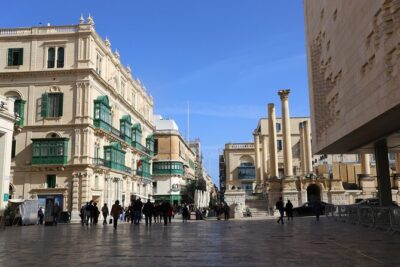
The Valletta Street Food and Culture Walking Tour
Read our review →Browse the lists this tour appears in