
Reviewed · CITY TOURS
Valletta City of Gentlemen guided walking tour
Gentle walking, big Valletta lessons fast. I really like how this tour hits the city’s big visual hits in a tight 2-hour route, and I also like the small group size that keeps questions coming. One thing to keep in mind is that it is outdoors and you should be comfortable walking for the full stretch, since the route is designed as a proper walking tour.
If you’re new to Malta, this is a smart way to get your bearings without getting lost in dates and names. A local guide handles the story and also helps you through local language barriers, so you can focus on the scenery and the meaning behind it. Bonus: most of what you see along the way is free public space, so you are not constantly hunting for tickets.
In This Review
- Key things to love about this Valletta walking route
- Two hours in Valletta: why this short walk is a win
- Meeting at Triton Fountain: the perfect opener
- Upper Barrakka Gardens: your quick lesson in the geography of Malta
- Lower Barrakka Gardens: Siege Bell, Sacra Infirmaria, and why it matters
- Strait Street, The Gut: from old vice to today’s dining street
- Grandmaster’s Palace, St John’s Co-Cathedral, and Parliament: seeing power without overloading
- Price and value: what $23.23 buys you
- The guide makes the difference: what you should look for on this tour
- Practical tips so the walk feels easy
- Who this tour suits best
- Should you book the Valletta City of Gentlemen guided walking tour?
- FAQ
- How long is the Valletta City of Gentlemen guided walking tour?
- Where does the tour start and end?
- What is the meeting start time?
- How much does the tour cost?
- What is included in the tour price?
- What group size should I expect?
- Is this tour mostly outdoors, or do I need entrance tickets?
- Is a mobile ticket used?
- What should I know about weather?
- What is the cancellation policy?
Key things to love about this Valletta walking route
- Triton Fountain as the starting point with a built-in historical story
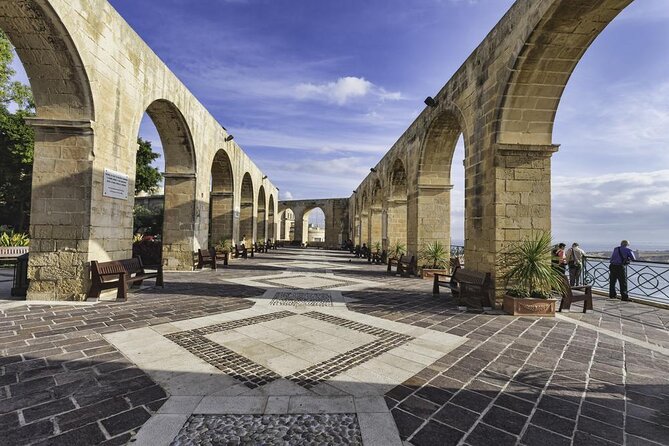
- Upper Barrakka Gardens panoramas over Grand Harbour and the Three Cities
- Lower Barrakka Gardens views plus Siege Bell and Sacra Infirmaria context
- Strait Street, The Gut, then to today with a feel for how the city changes
- Maximum 15 travelers for a more personal, question-friendly pace
- A guide who supports language barriers, so you can actually follow along
Two hours in Valletta: why this short walk is a win
Valletta is compact, but it can still feel like a maze at first. This tour works because it gives you a clear spine through the city: a landmark start, two viewpoints that explain the geography, then a stroll through streets tied to power and daily life. You spend enough time to understand what you are looking at, but not so long that you feel dragged around when you still want free time to explore on your own.
At about 2 hours, it also fits nicely into your first day or your half-day window. You get “oh, that’s where that is” moments early, which pays off later when you revisit places on your own. And since the group is capped at 15, it is not a herd shuffle. You can ask what something means, and the guide can steer the pace so you keep moving without feeling rushed.
More Guided Walks in Malta:


Meeting at Triton Fountain: the perfect opener
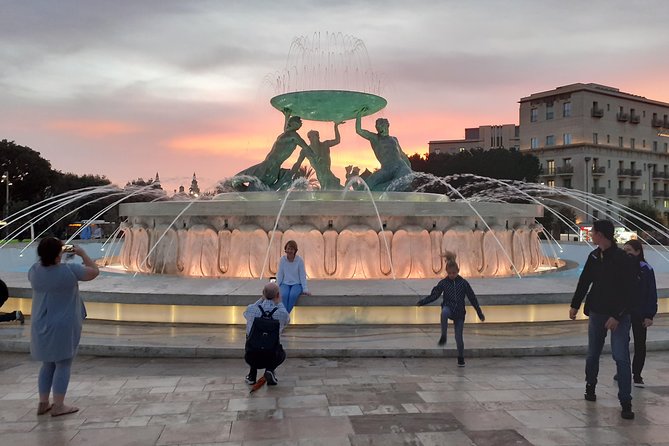
The tour starts at Triton Fountain, a real Valletta landmark at the city’s heart. It is not just a pretty meeting point. The fountain was designed and constructed between 1952 and 1959, and it was conceived jointly by sculptor Chevalier Vincent Apap, under the work of no less than three governing bodies. That kind of detail matters because it tells you something about modern Valletta too, not only the medieval stuff.
I like opening a walking tour with a spot everyone can locate. It immediately anchors you, so you stop thinking about navigation and start thinking about the city. From there, the route naturally leads you toward the viewpoints that explain how Valletta sits around its harbors.
Also, this is one of those moments where photos come easily. You are beginning in open space, so you can get your first shots right away, not later when everyone is tired.
Upper Barrakka Gardens: your quick lesson in the geography of Malta
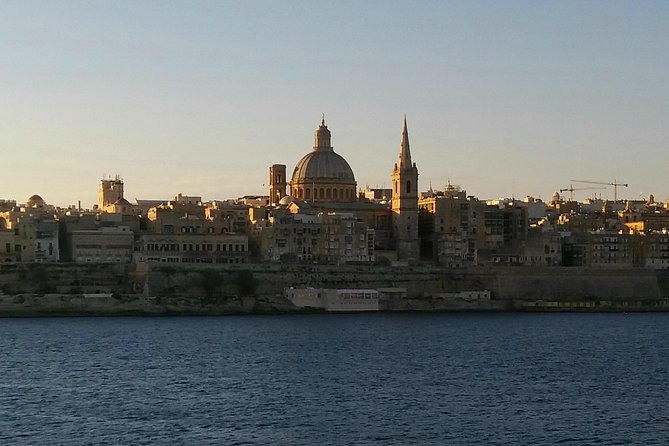
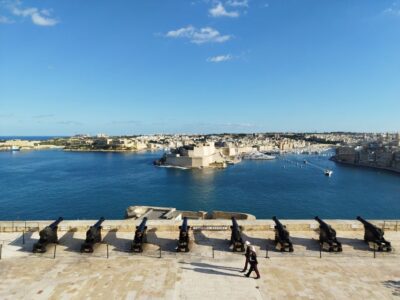
Next comes Upper Barrakka Gardens, a classic spot for views that actually teach. You get a panoramic look over Grand Harbour and the historical area known as the Three Cities. This is the kind of viewpoint that helps you understand why Valletta was so strategically important in the first place.
What I find useful is that the guide’s framing turns the view into information. Without that context, a panorama is just scenery. With it, you start to recognize how the water shaped trade, defense, and the day-to-day rhythm of the city.
This stop is also a practical break. The time here is built for taking photos and simply looking around. If you want to relax for a minute but still keep momentum, this is a good place to do it.
Lower Barrakka Gardens: Siege Bell, Sacra Infirmaria, and why it matters
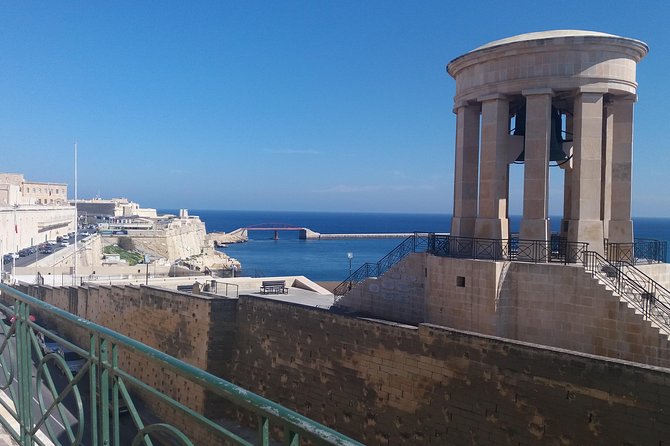
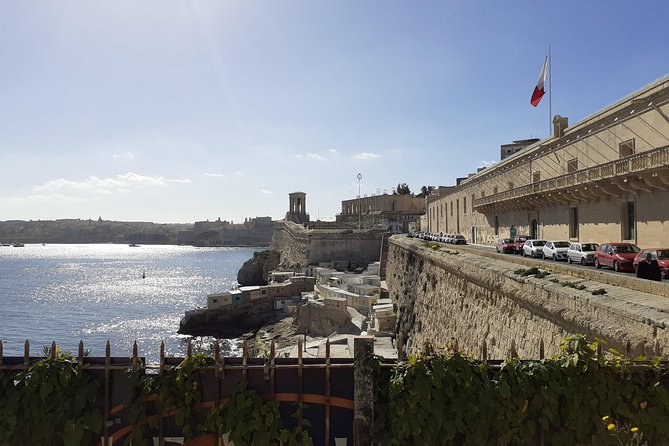
At Lower Barrakka Gardens, the view shifts in a way that feels like a reveal. You look toward the entrance of Grand Harbour, and you also hear and see the city through its landmarks, including the Siege Bell. Even if you are not an expert on Malta’s conflicts, the way the guide connects the bell to the historical story helps you place it emotionally, not just visually.
One of the most interesting parts of this stop is the reference to the Sacra Infirmaria, the Knights of St John hospital described as healing the sick and wounded without making distinction of creed, race, or social status. Today, it holds the Mediterranean Conference Center, and that contrast is worth noticing. You are looking at an old institution with a new role, which is a recurring Valletta theme: buildings that outlast their original purpose.
This is also your second dose of harbor views, which is great because it helps you build a mental map. You start to see how different viewpoints line up across the water.
Strait Street, The Gut: from old vice to today’s dining street
The walk then turns toward Strait Street, historically known as The Gut, when it served as Valletta’s red light district. The atmosphere today is far from that past. The old bars and haunts have been revamped and converted into trendy spots where people now dine and wine and have a good time.
I like this stop because it reminds you that cities are living things. Valletta is often marketed as a monument. This street quietly shows the other side: how life, culture, and nightlife evolve even when the street name and basic layout remain.
If you are a photo person, this is a good stretch to capture street-level detail. If you are planning to come back later for dinner, it gives you a head start on where the energy is concentrated.
More sightseeing loops around Malta:
- Gozo: City Sightseeing Hop-On Hop-Off Bus Tour★ 4.2 · 1,117 reviews
- Malta: City Sightseeing HOHO Bus Tour & Optional Boat Tour★ 3.4 · 1,021 reviews
- Valletta: City Walking Tour in a Small Group★ 4.9 · 957 reviews
- City Sightseeing Malta Hop-On Hop-Off Bus Tour + Bookable Extras★ 2.0 · 565 reviews
- Mdina and Rabat: Guided City Walking Tour★ 4.8 · 549 reviews
Grandmaster’s Palace, St John’s Co-Cathedral, and Parliament: seeing power without overloading
Along the route, the tour covers major symbols of government and religion, including the Grandmaster’s Palace, St John’s Co-Cathedral, and the Parliament of Malta. You may get views of them from the outside rather than a long interior experience, which keeps the walking tour format moving while still grounding you in key landmarks.
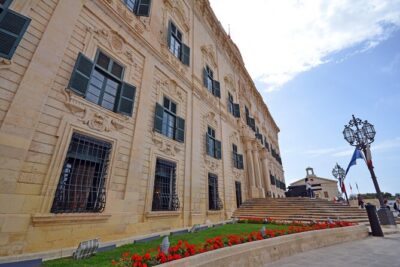
A highlight here is the outside view from the majestic Palace of the Grand Master, which has been used as the seat of government in Malta for a long time. When you see it from the street, it hits you how the architecture functions like a statement. The guide’s job is to explain the why, not only the what.
And because St John’s Co-Cathedral and the palace are so closely linked to Valletta’s identity, seeing them in the same flow helps you connect the dots. You are not jumping between far-flung sites. You are learning the city as one connected system of power, faith, and history.
Price and value: what $23.23 buys you
The cost is $23.23 per person, and it is for a guided walking experience of about 2 hours. That price is reasonable for three reasons.
First, you are paying for interpretation, not just movement. A good guide turns “I saw a fountain and some gardens” into “I understand what those features were for.” Second, the group size is capped at 15, which usually means you get more attention than you would on larger tours. Third, many stops are free public spaces, so you are not adding entry-ticket costs to your day.
So, what you get is a guided orientation, not an all-day museum sprint. If you want a quick, guided path through Valletta’s most recognizable highlights, this price fits the goal.
The guide makes the difference: what you should look for on this tour
The tour notes emphasize that the guide helps you navigate local language barriers, and that matters more than it sounds. Malta has its own rhythm and pronunciation, and if you are trying to translate everything on the fly, you miss the story. A guide who can explain clearly keeps your attention on what you are seeing.
One standout example from a guide’s performance is Julia, described as fantastic: very knowledgeable, personable, and a strong storyteller. That kind of approach is what turns the walk into learning you will remember.
Since the tour is short, you should expect the guide to be efficient and organized. Your job is simple: ask questions when you have them, and take your time during the viewpoints so you do not rush through the scenes the guide is using to teach.
Practical tips so the walk feels easy
This experience is near public transportation, which helps if you are staying in another part of Malta. The tour uses a mobile ticket, which is handy for getting on track quickly.
Start time is 11:00 am, and the tour begins at Triton Fountain and ends at St George’s Square in Valletta, near Republic Street. Plan for the route to take you into the most walkable parts of the city, which is great, but it does mean you should wear shoes you trust.
A quick note on comfort: the tour is described as something most people can participate in, as long as you can walk. It is not framed as a sit-everywhere experience. If you know you are limited with time on foot, consider whether you can handle an uninterrupted walking tour for roughly two hours, plus short pauses for views and photos.
Finally, weather matters. The tour is marked as requiring good weather, so you should keep an eye on skies on the day you book. If conditions are poor, you will be offered a different date or a full refund.
Who this tour suits best
This is a strong choice if you:
- Want a first-day orientation that helps you navigate Valletta with confidence
- Like viewpoints and photo stops that explain where you are looking
- Prefer a small group and a guided pace over an audio-only experience
- Want a local guide who can handle language gaps so you understand the story
It is also a good option if you are short on time but still want key Valletta landmarks connected into a coherent route.
If you are the kind of traveler who only wants long museum hours or deep interior visits, you might find this too brief. The format is designed to get you moving and seeing, not to keep you inside for hours.
Should you book the Valletta City of Gentlemen guided walking tour?
Yes, I think you should book it if you want an efficient, guided path through Valletta’s most recognizable anchors, with viewpoints that actually teach you geography and history. The biggest selling points for me are the small group size, the guide support for language barriers, and the way the route lines up major landmarks so you build a mental map quickly.
Book it sooner if you can. It is noted as being commonly booked about 30 days in advance, which suggests it often fills up for the simple reason that it is a good first overview.
If you are comfortable walking for about two hours and you are traveling in decent weather, this tour is a smart value use of time. It should leave you with both better context and better confidence, so your free exploration afterwards is more enjoyable and less guesswork.
FAQ
How long is the Valletta City of Gentlemen guided walking tour?
The tour is approximately 2 hours.
Where does the tour start and end?
It starts at Triton Fountain (Vjal Nelson, Il-Furjana) and ends at St George’s Square (Republic St, Valletta).
What is the meeting start time?
The start time is 11:00 am.
How much does the tour cost?
The price is $23.23 per person.
What is included in the tour price?
The tour includes a tour guide.
What group size should I expect?
The tour has a maximum of 15 travelers.
Is this tour mostly outdoors, or do I need entrance tickets?
It is a walking tour focused on public landmarks and viewpoints, and the stops listed show free admission.
Is a mobile ticket used?
Yes, it uses a mobile ticket.
What should I know about weather?
The tour requires good weather. If it is canceled due to poor weather, you will be offered a different date or a full refund.
What is the cancellation policy?
You can cancel for a full refund up to 24 hours in advance. Cancellations less than 24 hours before the start time are not refunded, and local time cutoffs apply.
Just landed: new Malta pages




City Tours, compared.

City Sightseeing HOHO Bus Tour & Optional Boat Tour
Read our review →

City Sightseeing Malta Hop-On Hop-Off Bus Tour + Bookable Extras
Read our review →

Browse the lists this tour appears in